(TITC) - According to a newly released Barometer report by UN Tourism, international tourist arrivals worldwide reached approximately 307 million in the first quarter of 2026, marking a 2% increase compared to the same period in 2025 - equivalent to an additional 6 million visitors.
Middle East crisis casts a shadow over global tourism
UN Tourism Secretary-General Shaikha Al Nuwais said: “The ongoing conflict in the Middle East is disrupting travel patterns well beyond the region itself, including rising inflation, particularly in transport and accommodation. This is placing pressure on travelers, businesses and destinations alike. Even amid this uncertainty, international tourism continued to show resilience in the first quarter of 2026, with 307 million people traveling internationally, a 2% increase on last year. At a time of growing geopolitical and economic pressure, this reinforces tourism’s wider role in supporting economies, creating opportunity and sustaining communities far beyond the sector itself.”
UN Tourism forecasts that the Middle East crisis could limit global international tourist growth in 2026 to just 1–2%, down from the earlier projection of 3–4%. Beyond direct disruptions to regional air routes, rising oil prices and jet fuel shortages in some markets are increasing transportation costs, reducing airline capacity, and negatively affecting traveler sentiment. As a result, demand is expected to shift further toward nearby destinations.
According to the UN Tourism Panel of Tourism Experts, the three biggest challenges facing global tourism in 2026 are the Middle East conflict, rising transport costs, and higher accommodation prices alongside broader economic pressures. Up to 64% of experts believe conflicts are negatively impacting tourism demand in their destinations, while 61% report a decline in international arrivals due to geopolitical developments.
In this context, travelers are expected to continue prioritizing affordable, high-value trips and choosing closer destinations to minimize risks and additional costs.
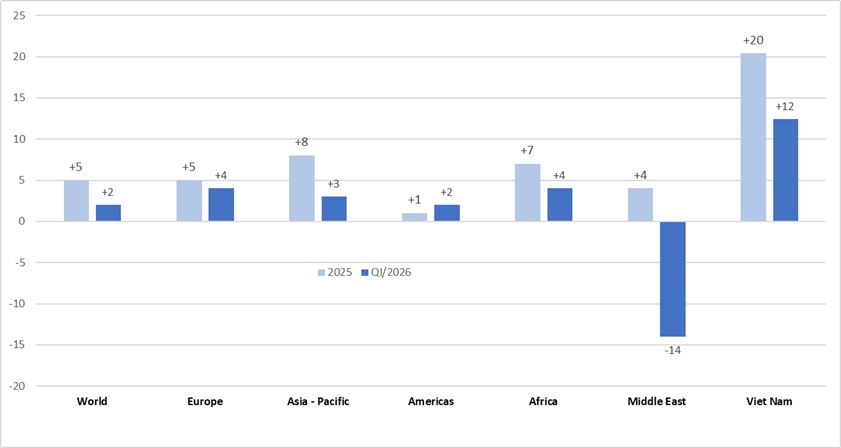
International tourist arrivals (% change over previous year)
Asia’s tourism growth slows
UN Tourism reported that Europe remained the world’s largest destination region, receiving over 130 million international arrivals in Q1/2026, up 4% year-on-year. Africa also grew by 4%, while the Americas increased by 2%. In contrast, the Middle East recorded a sharp 14% decline due to geopolitical tensions, highlighting ongoing challenges for both regional and global tourism.
Asia-Pacific recorded a 3% increase in international arrivals in Q1/2026, below expectations due to uneven recovery across destinations. After a strong 9% growth in February, the region slowed to just 2% in March, mainly due to air travel disruptions linked to the Middle East conflict, which significantly reduced arrivals in South Asia.
By subregion, Oceania grew 9%, Northeast Asia 5%, while Southeast Asia recorded only 1.1% growth.
UN Tourism noted that international arrivals to Asia in Q1/2026 had only recovered to around 89% of 2019 levels, reflecting a slow recovery as the global tourism sector enters the post-pandemic growth phase.
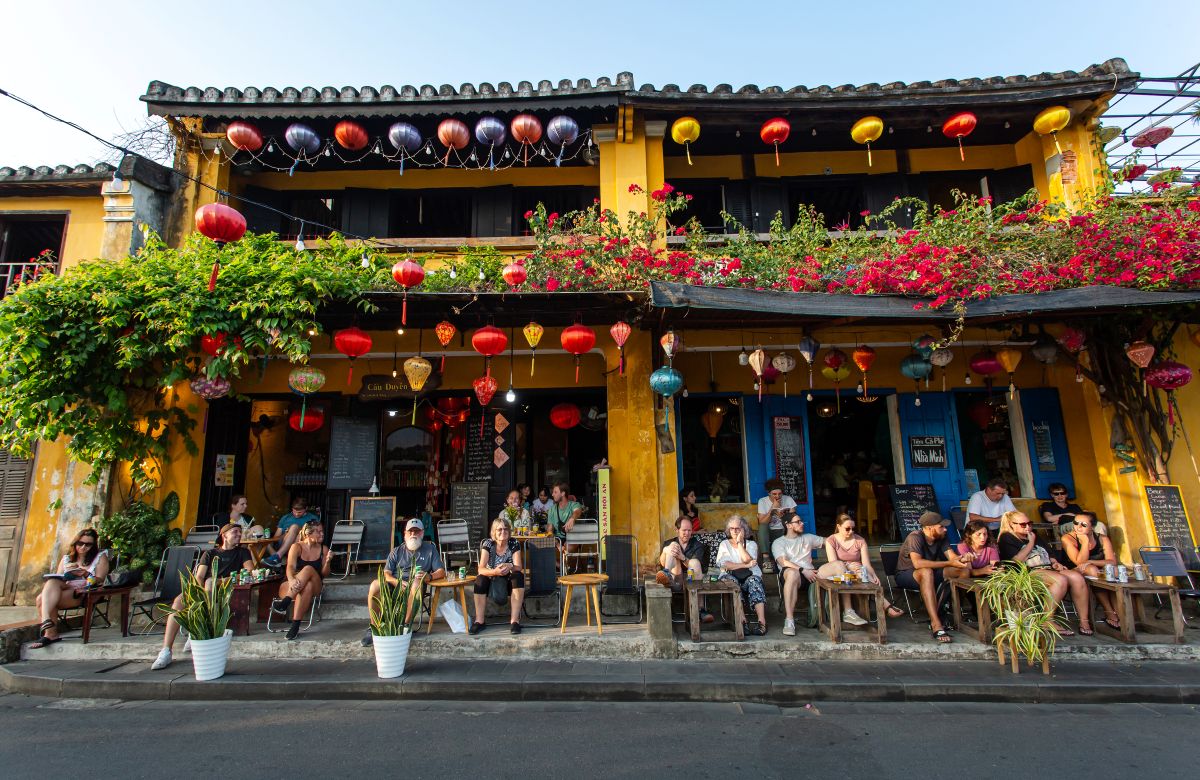
International tourists at Hoi An Ancient Town, Vietnam. Photo: Tien Studio
Vietnam stands out amid global uncertainty
Amid the subdued performance across Asia, Vietnam emerged as a bright spot, recording 12.4% growth in international arrivals in Q1/2026 compared to the same period last year - four times higher than the regional average. This momentum continued into the first five months of the year, with international arrivals to Vietnam increasing by 14.9%, reflecting the country’s growing attractiveness on the regional and global tourism map.
These positive results are supported by multiple favorable factors, including a safe and secure environment, friendly people, socio-economic stability, and an increasingly diverse and attractive range of tourism products and services. In addition, Vietnam’s growth also reflects effective tourism promotion efforts, market expansion, visa and immigration facilitation policies, and improved international air connectivity.
In the context of ongoing global economic and geopolitical uncertainty, these results demonstrate the resilience, adaptability, and sustained growth momentum of Vietnam’s tourism sector.
Tourism Information Technology Center